
In 1932, architect Georges-Henri Pingusson completed Latitude 43, a hotel whose imposing silhouette overlooks the Gulf of Saint-Tropez. A true manifesto of modern architecture in southern France, it remains the defining masterpiece of its designer’s career and established his reputation from the moment of its inauguration. In 1992, the building was listed as a Historic Monument, becoming one of the first 20th-century structures in France to receive this distinction.
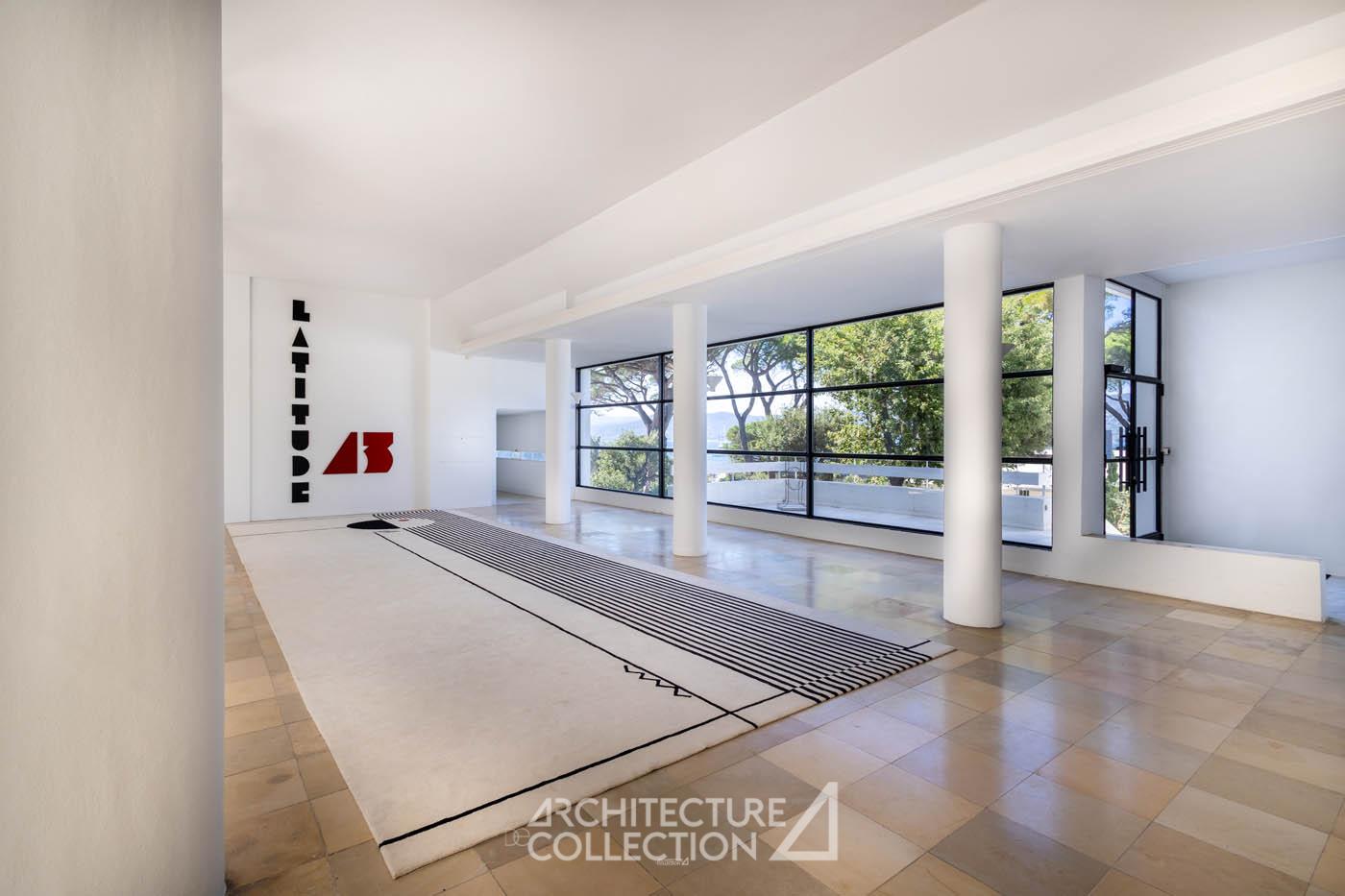
Entrance hall © Valérie Ruperti
A building of many lives
The project was born from a meeting on the harbour of Sainte-Maxime between architect Georges-Henri Pingusson and Georges Béret, a former manager of several Parisian hotels. As the owner of a seven-hectare site on the outskirts of Saint-Tropez’s historic centre, Béret envisioned a highly ambitious hotel designed to attract an artistic and intellectual elite. Yet the village’s still modest character, combined with an unfavourable socio-economic climate, prevented Latitude 43 from achieving the success its promoters had anticipated.
The building was inaugurated on 14 July 1932, following an exceptionally rapid six-month construction campaign. Open for only a few seasons, it was successively requisitioned by French, Italian, German, and American forces during the Second World War. Between 1945 and 1947, it served as a rehabilitation and rest centre for former concentration camp detainees before being converted into a condominium residence in 1949.

© Aerial view, Monuments historiques, Sylvie Denante
A High-Tech complex between hygienist ideals and resort culture
The original programme was particularly ambitious, comprising a luxury hotel with 110 guest rooms, a restaurant, a modern sports complex featuring swimming pools and tennis courts, as well as a casino and a range of retail spaces.
Pingusson conceived the building as a slender linear block extending over 100 metres in length, curving 45 degrees to the west, notably to reduce the length of the internal access galleries. Its pronounced horizontality gradually gives way, towards the western end, to an asymmetrical stepped composition that mitigates the building’s monolithic appearance, alongside vertical circulation towers that punctuate the overall massing. The purity of its lines—at times rigorous, at others remarkably fluid—endows the structure with a distinctive elegance. Devoid of ornamentation and unified by a continuous white-rendered façade, the building exemplifies the aesthetic principles of modern architecture.

© East and South elevations

This main volume houses the reception areas and guest rooms, which benefit from a dual “sun–sea” orientation thanks to low-level corridors positioned at mid-height. The bar and restaurant occupy two levels within a volume connected to the reception through a system of terraces, while the remainder of the programme is distributed throughout the surrounding park. An Olympic-sized seawater swimming pool and a casino/dance hall, both open to the public, are located at the lower end of the site, near the national road.
Concepts of comfort, ease, and health, of both body and mind, guided the modern architect in the design of the hotel. The relationship to nature is omnipresent, as is the presence of sunlight and fresh air, which penetrate the building through large horizontal ribbon windows.

© North elevation
Between Nautical References and Corbusian Influences
At a time when transatlantic liners had become powerful symbols of modernity and escape, Pingusson drew direct inspiration from them, giving his hotel the appearance of an ocean liner. The continuous relief of recessed walkways and terraces evokes the slender lines of promenade decks, enhanced by porthole-like windows and a sculptural funnel crowning the composition.
The architect also pays tribute to the principles theorised in France by Le Corbusier, through a faithful and rigorous application of the Five Points of a New Architecture (1927), here fully implemented in both elevation and plan: pilotis, ribbon windows, roof terrace, free plan, and free façade.

© Perspective and advertising poster of Latitude 43

A Synthesis of the Arts
At Latitude 43, no detail escapes the forms of modernity: the architect designs not only the furniture, but also the lighting fixtures, carpets, staff uniforms, and even the advertising posters. The guest rooms, through the restraint of their interior decoration, echo the austerity of the building’s external volumes. Their furnishings are based on tubular steel structures, in the spirit of the Bauhaus and the Union des Artistes Modernes (UAM), founded in 1929 and joined by Georges-Henri Pingusson three years later.
Several artists were brought together for this large-scale project. The lobby was first conceived as a major focal space, adorned with a monumental mural by the English painter Harry Bloomfield, while the guest rooms were enhanced by works by another English artist, Roger Nickalls.

© Entrance canopy
Georges-Henri Pingusson
Architect and urban planner Georges-Henri Pingusson (1894–1978) first obtained, in 1913, a degree in engineering from the École spéciale de mécanique et d’électricité in Paris, in preparation for succeeding his father in industry. Ultimately turning away from this path, he enrolled at the École des Beaux-Arts in Paris after the First World War, during which he fought in the Dardanelles and studied architecture in the studios of Gustave Umbdenstock and Paul Tournon. Graduating in 1925, he began his career in partnership with architect Paul Furiet (1898–1930). Together, they designed numerous villas, often in a regionalist style, in the Basque Country and on the French Riviera, and also co-signed the Arrighi power plant in Vitry-sur-Seine.
After the Second World War, Pingusson was appointed chief architect for reconstruction in the Moselle region. He designed the French Embassy in Saarbrücken and contributed to urban planning schemes around Metz, Sarreguemines, and Briey-en-Forêt, where he invited Le Corbusier to build his Unité d’Habitation. He also led the reconstruction of the villages of Waldwisse (1955) and Grillon (1978, completed pro bono), as well as several churches (Nativity of the Virgin Mary in Fleury, 1963; Saint-Martin-Évêque in Corny-sur-Moselle, 1960; Saint-Antoine in Boust, 1963) and the Deportation Memorial in Paris. A professor at the École des Beaux-Arts in Paris and later at the École d’architecture Paris-Nanterre, Georges-Henri Pingusson remains a highly regarded figure in 20th-century architectural history.
Are you the owner of an iconic building in Saint-Tropez and looking to have its value assessed? Would you like to pass on your property to a buyer who is both discerning and capable of preserving it ? Or are you searching for a remarkable architectural property on the French Riviera?
Our dedicated team is here to assist you !
