
Un temps hôtel puis résidence, Le Majestic est aujourd’hui encore l’un des édifices les plus emblématiques de la ville de Nice, reconnu pour son raffinement décoratif. L’inscription de certaines de ses parties au titre des Monuments historiques en 2021, confirme ce statut d’exception et consacre sa valeur patrimoniale.

© Elodie Gutbrod
Nice au tournant du XXème siècle, un lieu de villégiature privilégié
A partir du XVIIIème siècle, Nice devient un lieu de villégiature hivernal pour les grandes familles aristocratiques et la haute société, notamment britanniques, attirées par la douceur de son climat et sa situation sur la Riviera. Le nombre d’hivernants ne cesse de croître, en particulier dès 1860, lorsque la ville, cédée à la France, est raccordée au réseau ferré européen.
Cet afflux de populations étrangères façonne le paysage urbain de Nice, amenée à développer de nouveaux quartiers et construire certaines typologies d’édifices : hôtels, villas, immeubles d’agrément, opéra, casino.

© Elodie Gutbrod

Une richesse architecturale et ornementale
Le Majestic, construit entre 1906 et 1908, à la demande des hôteliers suisses Henry et Lucien Emery, prend part au mouvement et incarne l’esprit architectural de la période. Il est le plus grand hôtel de la ville, avec ses 175 mètres de long, 44 mètres de haut et 9 étages, abritant jusqu’à 500 chambres et des équipements luxueux pour l’époque (salons, restaurants, ascenseurs).
L’ensemble consiste en une forme monumentale et longiligne, se courbant à l’ouest, et à laquelle viennent se greffer deux petits volumes. De la toiture à pans inclinés jaillissent deux chapeaux de tour, semblables à des clochers. Ces diverses émergences, couplées à une façade principale très dynamique, permettent de prévenir tout effet monolithique.
Cette façade, très ordonnancée, est marquée par un jeu de ressauts et ponctuée de travées concaves. La modénature et l’ornementation y sont particulièrement riches et éclectiques : corniches sculptées dessinant des formes géométriques ou végétales, ouvrages de ferronnerie, colonnes engagées et médaillons. Pour les premiers niveaux, l’architecte abandonne la pierre lisse, au profit d’un traitement en bossage plat, donnant à l’édifice une allure plus ferme et solide. Ces nombreux éléments décoratifs concernent seulement la façade sud, la façade nord en étant complètement dépourvue.

© Elodie Gutbrod

Durant la Première Guerre mondiale, l’hôtel est transformé en hôpital militaire, puis repris en 1924 par l’hôtelier Joseph Aletti. L’architecte Charles Dalmas, assisté de son fils Marcel et de Marcel Guilgot, intervient pour moderniser l’ensemble, intégrant dans le parc les boutiques de luxe, transformées en petites maisons à un étage. La Seconde Guerre mondiale marque un temps de fermeture pour l’hôtel, qui ne rouvre pas à l’issue du conflit. Le promoteur Victor Saglia en fait l’acquisition et le transforme en une copropriété de 220 lots, dont la réalisation est confiée à Louis Milon de Peillon.

© Elodie Gutbrod
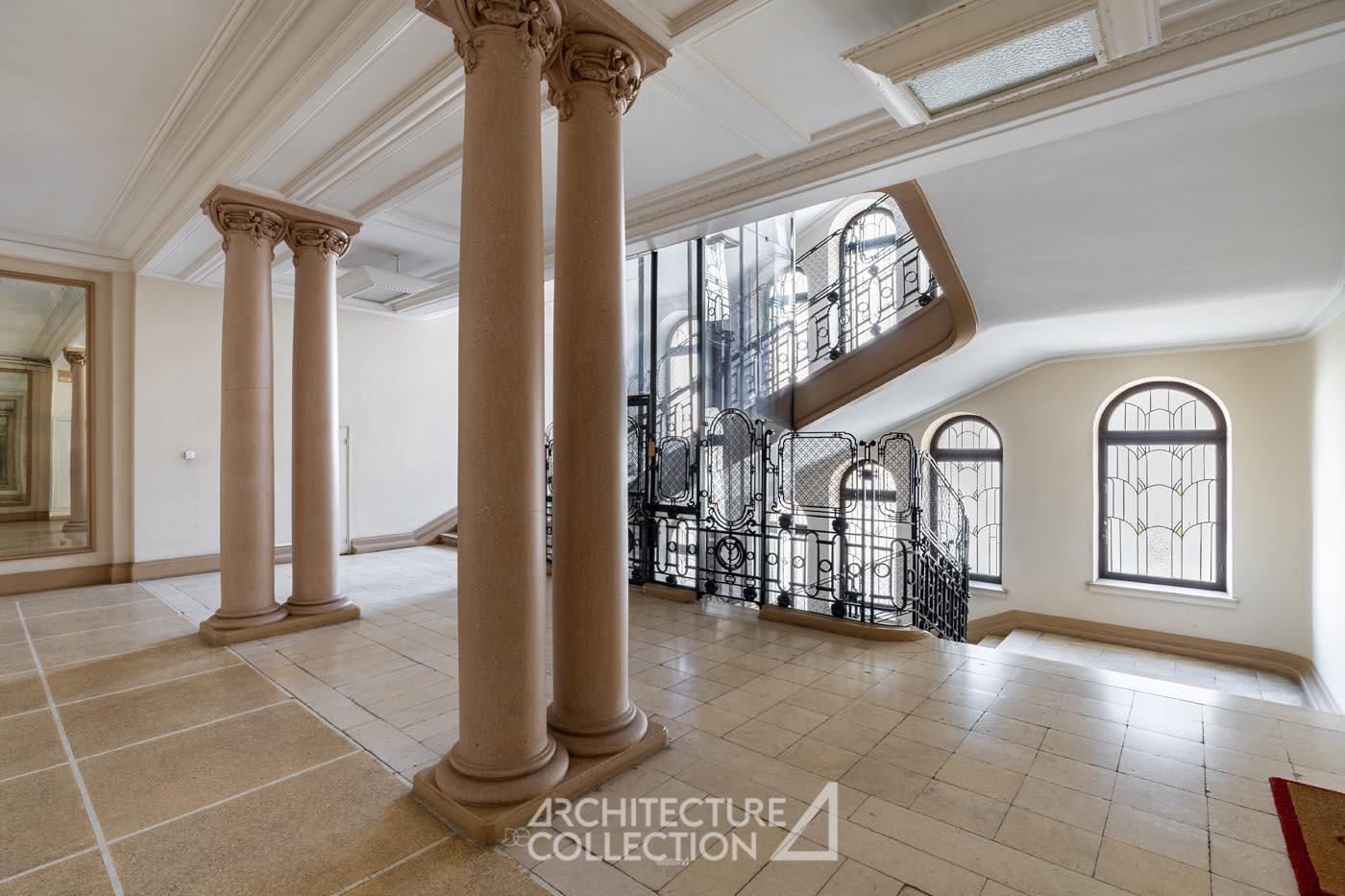
Ces fonctions successives modifient profondément l’aménagement intérieur du Majestic. Dans les années 1930, les pièces de réception sont allégées de leur décor, certains éléments étant repris dans un style Art déco. Cet allégement s’intensifie par la suite, lors de la transformation de l’édifice en copropriété.
Néanmoins, les parties communes et l’ascenseur imposant, ainsi que des détails tels que le travail de menuiserie, les escaliers en pierre, les colonnes et les vitraux géométriques, rappellent le passé fastueux de l’édifice. Les architectes en charge des modifications ont toujours veillé à conserver la qualité des espaces, faisant subsister les larges couloirs et halls majestueux.


© Le Majestic (1909-1930) et photographie ancienne de la salle de bal (1910) – Ministère de la culture, DRAC PACA, Conservation régionale des Monuments historiques
Jules Febvre
Architecte niçois formé à l’École des Beaux-Arts de Paris, Jules Febvre (1859-1934) marque de son empreinte le paysage architectural de Nice à son retour dans la région. Polyvalent et prolifique, il signe aussi bien des bâtiments publics que des logements ou des édifices religieux, contribuant activement à la transformation urbaine de son époque. Parmi ses réalisations, le Majestic reste l’une de ses œuvres les plus ambitieuses.
Vous êtes propriétaire d’un bien situé dans Le Majestic ou d’un édifice emblématique à Nice et souhaitez faire estimer sa valeur ? Vous souhaitez transmettre votre bien à un acquéreur sensible et en capacité de le préserver ? Vous êtes en recherche d’un bien remarquable à Nice ?
Notre équipe spécialisée est à votre écoute !
