
par Jacinthe Gigou
A bespoke formula for Carlo Scarpa, that master of shadow and light, who turned detail into a true language. An unclassifiable architect, little known during his lifetime, he has sparked growing interest in recent years. As a new venue has recently opened to the public in Venice, we look back at a peerless body of work, more relevant than ever.
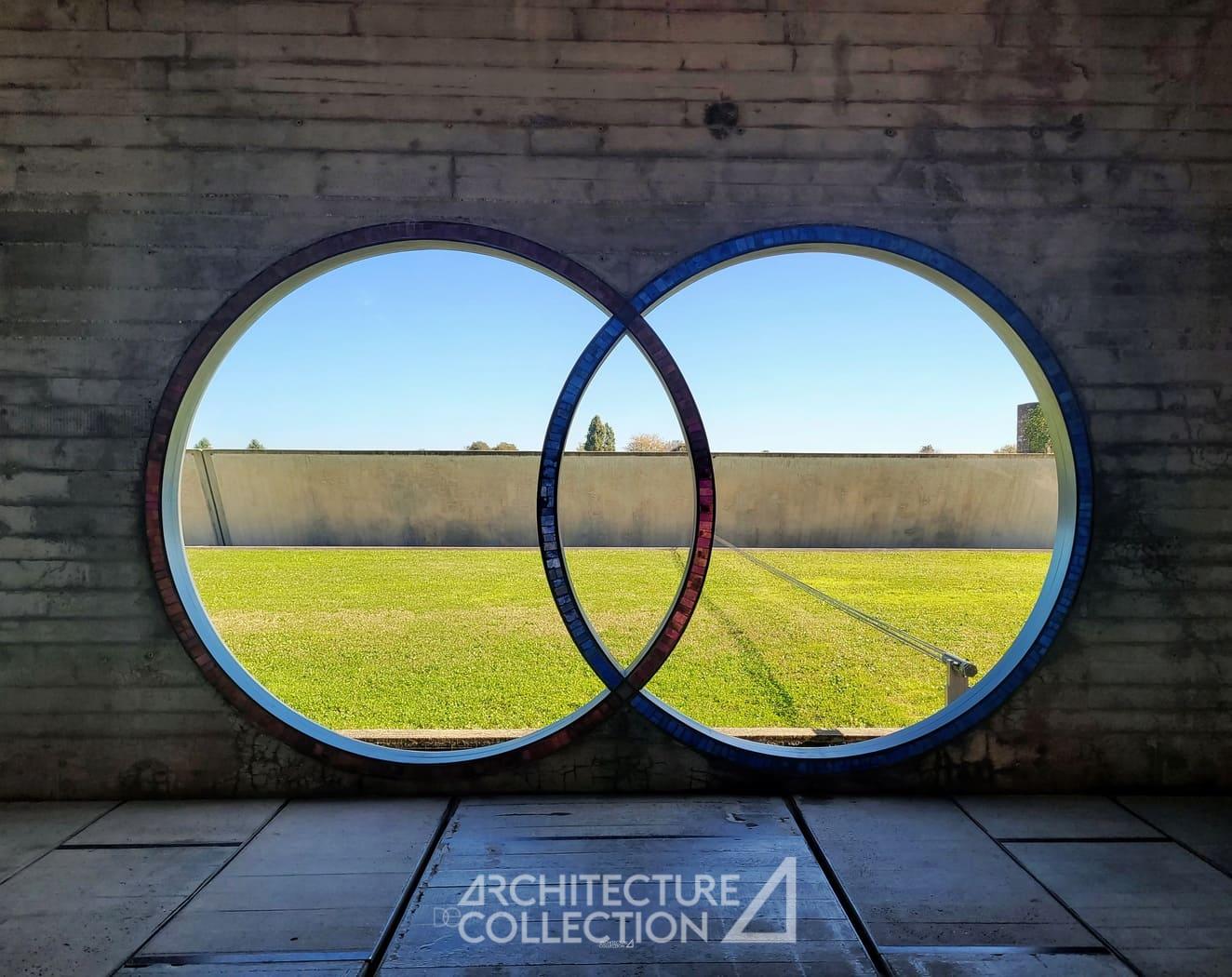
Brion Tomb, 1970-1978 © Jacinthe Gigou
The reflection of a grille in the lagoon’s water, the gleam of gold at the heart of raw concrete, diagonal staircases : so many small nothings that make up everything. Neither a dogmatic modernist nor a brutalist, Carlo Scarpa (1906-1978) defies categorization. His architecture, as radical as it is refined, is both modern in its materials and deeply rooted in history. An “in-betweenness” that makes his creations inimitable.
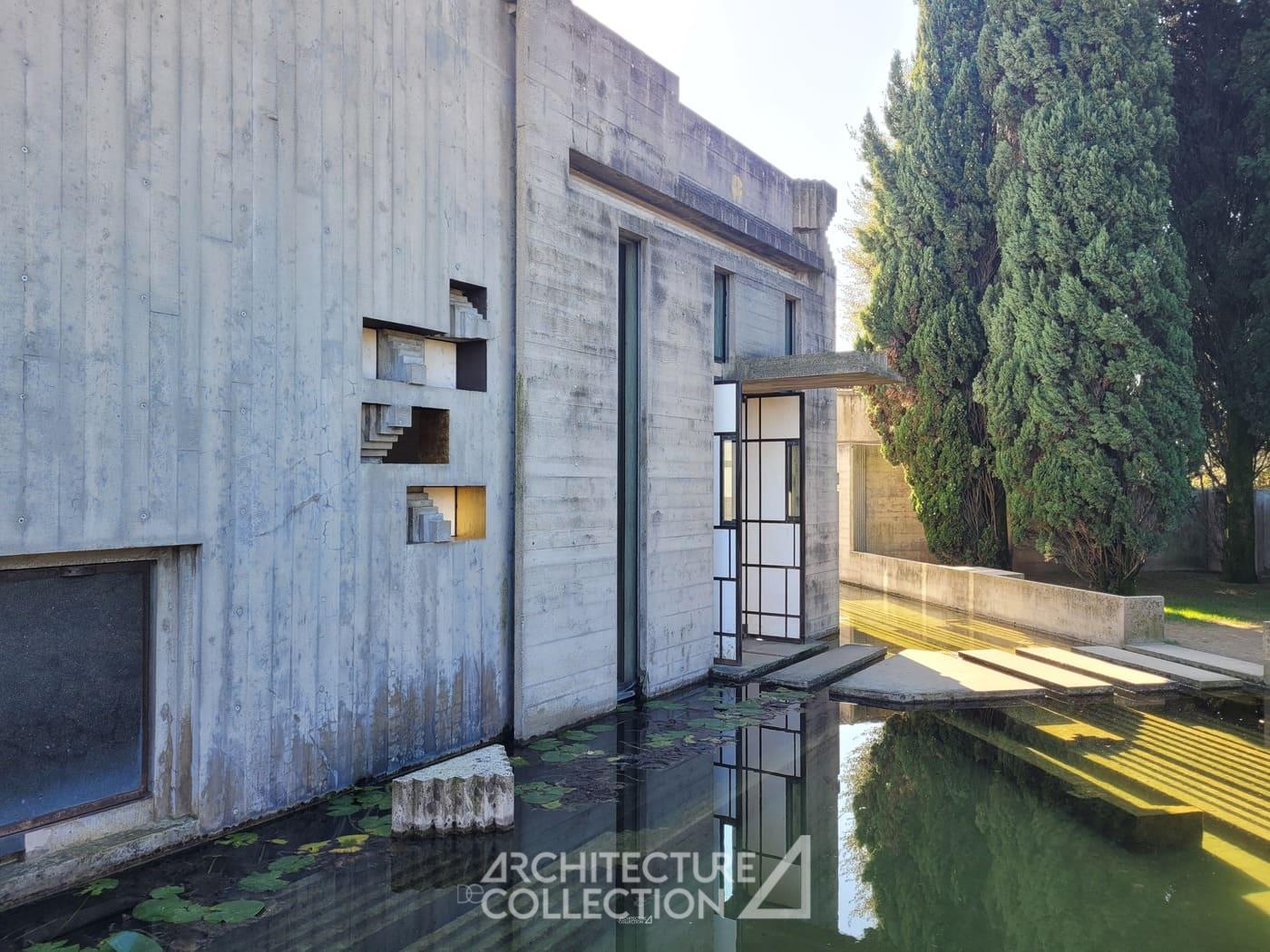
Brion Tomb, 1970-1978 © Jacinthe Gigou
Venice’s prodigy
The bond between Scarpa and Venice is a long one. Carlo was born there on June 2, 1906, to a professor father and a seamstress mother, knowledge and precision, two essential criteria for the creator, evident in all his projects. As the gateway to the Orient, a crossroads of cultures and eras, La Serenissima was an inexhaustible source of inspiration for Scarpa. He studied at the Academy of Fine Arts, graduating as an architectural draftsman. He frequented the iconic venues of Venetian intellectual life, such as Caffè Florian in St. Mark’s Square, where he built a network of artistic friendships. His talent emerged early: at just 21, he became artistic advisor to the Cappellin glassworks in Murano, later collaborating with Paolo Venini. For 14 years, he created glass objects that made Venini famous worldwide.

Showroom Adriano Olivetti, Saint-Marc place in Venice, 1957-1958 © Jacinthe Gigou

In 1942, he took on a key role for the city : architect-scenographer of the Venice Biennale, a position he held for nearly 30 years. He organized major exhibitions, such as those of Paul Klee and Toulouse-Lautrec. For the Biennale, he designed the new ticket office in the Giardini, a light structure resembling a miniature boat with a sail for a roof, as well as the Italian pavilion’s Zen garden and the Venezuelan pavilion, a concrete bunker currently under restoration. In 1957, Adriano Olivetti, head of the eponymous company, entrusted him with the design of the Olivetti showroom on St. Mark’s Square: “I would like you to design a calling card for Olivetti on the most beautiful square in the world.” Far more than a commercial showcase, the space became a manifesto of Scarpa’s architecture: precision of detail, spatial quality, mastery of light and materials. In total, Scarpa completed no fewer than 21 projects in Venice, making the city his favorite playground.

Showroom Adriano Olivetti, Saint-Marc place in Venice, 1957-1958 © Jacinthe Gigou
Rebirth
Still in Venice, on the Grand Canal, a 17th-century palace is adorned with a grille bearing a distinctly Scarpian motif. This is the Palazzina Masieri, restored by Carlo Scarpa in the 1960s. Long closed to the public, it has now been given new life thanks to the installation of the Parisian gallery Negropontes. The recent restoration, led by architects Roberta Bartolone and Giulio Mangano in collaboration with the Università IUAV di Venezia, reveals the full modernity of Scarpa’s intervention: exposed concrete, brass and bronze inserts, charred wood, and preservation of the building’s historic envelope. The gallery now fosters a subtle dialogue between the works it presents and the architecture of the space, a beautiful rebirth.

Palazzina Masieri, 1968-1983 © Jacinthe Gigou

Wabi Sabi
Beyond Venice, Carlo Scarpa was a connoisseur of Japan long before he traveled there. His first visit was in 1969, for the Design of Italian Furniture exhibition in Tokyo, organized by Cassina and designed by his son, Tobia Scarpa. From Japan, he retained a love for natural materials, wood, stone, and water, a recurring thread in his projects, as well as respect for the site, the interplay of shadow and light, and minimalism.
Among his works infused with Japanese influences is the renovation and extension of the Querini Stampalia Foundation in Venice. He remodeled this vast 16th-century palace in the 1950s, designing a kind of water and concrete labyrinth, a choreographed maze leading visitors to a hidden garden. A true secret Eden, it is adorned with multiple pools and fountains, papyrus, and water lilies, a small, incredibly peaceful paradise in the midst of a bustling neighborhood.

Querini Stampalia, 1959-1963 © Jacinthe Gigou

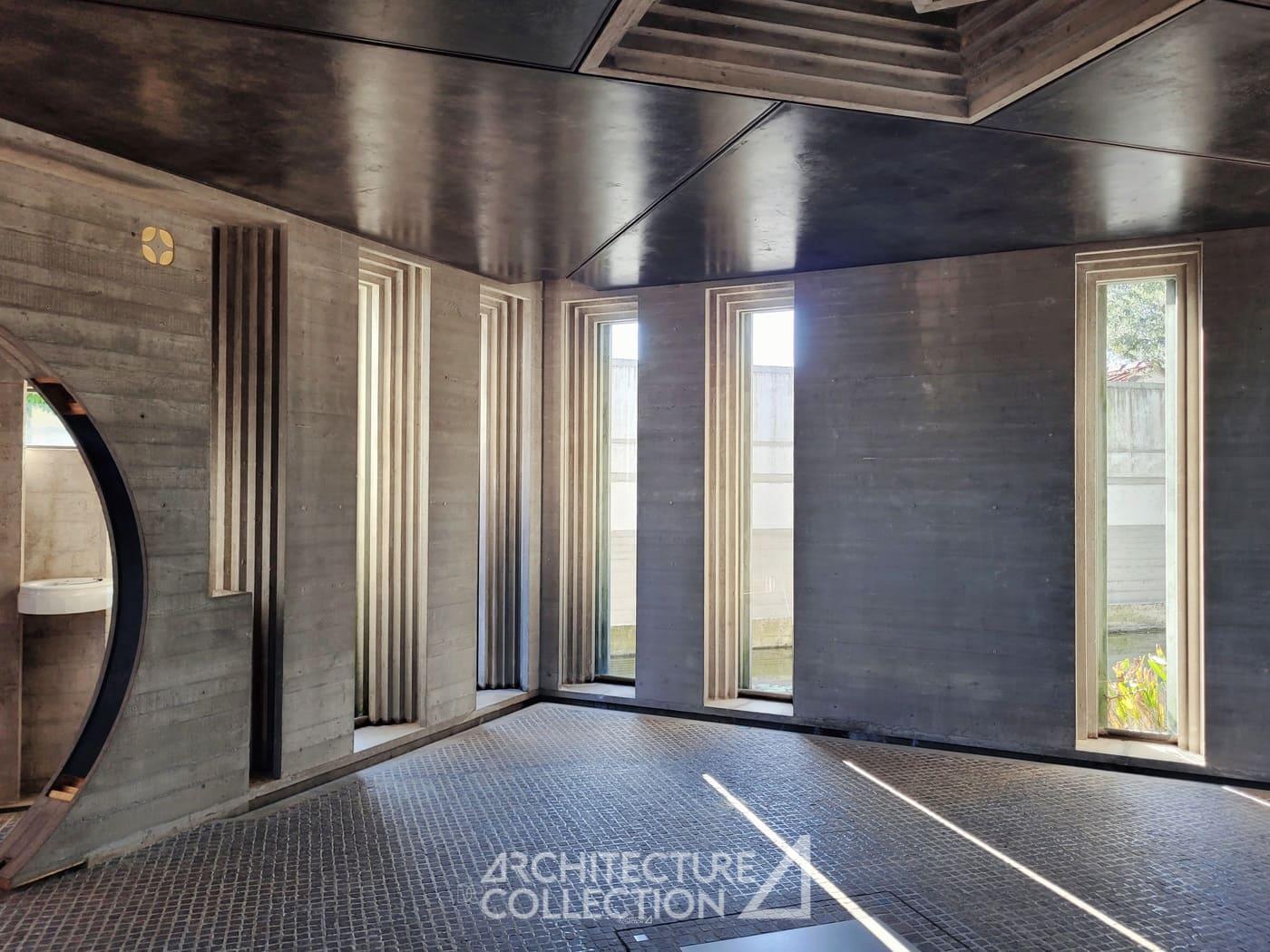
Another example of Japonisme is the Brion Tomb, located in San Vito d’Altivole, near Treviso. In the heart of the Veneto countryside, Carlo Scarpa designed this funerary mausoleum between 1970 and 1978 for the wealthy Brion family, industrialists in the electronics sector. Covering a total area of 2,000 square meters, it includes two futuristic sarcophagi for the deceased couple, a meditation pavilion, and a chapel, surrounded by pools and canals. Considered Scarpa’s masterpiece, this ensemble of rare beauty showcases his vast knowledge of architecture and the arts. The site is filled with symbols, the most famous being the motif of two interlocking circles – one red, one blue -representing the couple united for eternity. In 2022, the science fiction film Dune, Part Two was filmed here. In 1978, Scarpa died in an accident in Sendai, Japan. He is buried next to the Brion Tomb, which he was finalizing at the time.
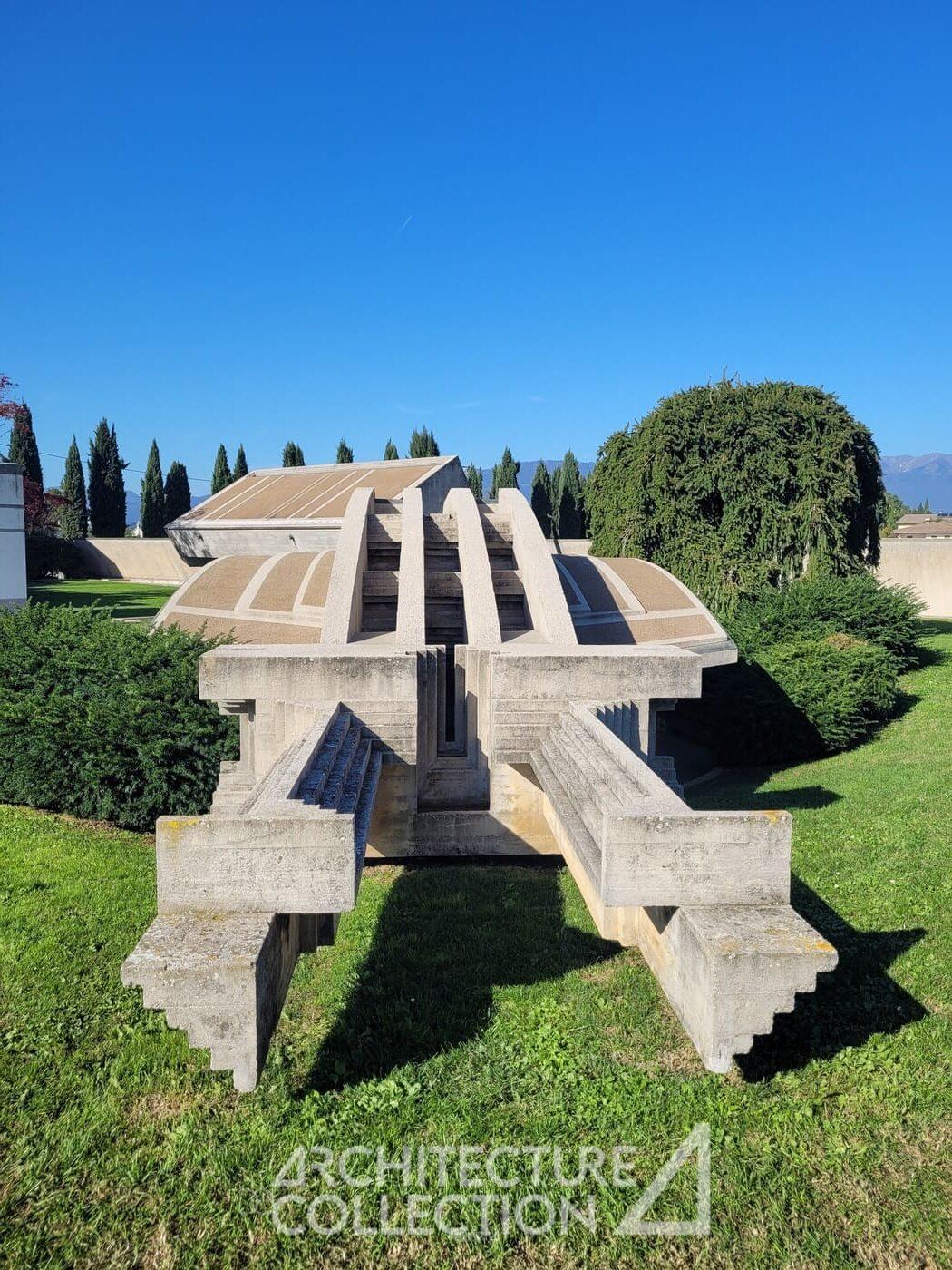
© Brion Tomb, 1970-1978, Jacinthe Gigou

Contemporary legacy
“I chose architecture as a necessity,” Carlo Scarpa said in a 1972 filmed interview, Un’ora con Carlo Scarpa. He conceived of architecture and design as a craft of excellence, where the pursuit of formal perfection was constant, even in almost imperceptible details. Although he taught at the Venice School of Architecture from the age of 27, his true legacy spread through his buildings. He continues to inspire many contemporary architects and designers, such as Tadao Ando, Álvaro Siza, and Peter Zumthor. In an interview, Ando recalled : “Carlo Scarpa taught me that architecture is not about form but about depth, the depth of space and the dignity of materials.” For his Punta della Dogana conversion project in Venice, Ando incorporated new windows and doors along the waterfront, clad in steel grilles explicitly referencing those of the Olivetti shop. The Swiss architect Peter Zumthor, in turn, explained : “Scarpa shows that architecture is made of attention, attention to materials, to joints, to how things meet.” In his projects, as in Scarpa’s, space becomes a true temporal experience. Meanwhile, in Belgium, the young Ghent architect Aurélie Penneman recently renovated an apartment in Knokke with Venetian glass mosaic floors inspired by the Olivetti store. The Italian master leaves a universal mark, touching all generations.

Brion Tomb, 1970-1978 © Jacinthe Gigou
Meticulous in detail, almost mannerist in his approach, Carlo Scarpa created unique, enchanting worlds. A constant source of inspiration, he invites us to a slow, contemplative spatiality, profoundly soothing in our world of immediacy.
JACINTHE GIGOU

Jacinthe Gigou is an art and architecture historian specializing in modern heritage. Based in Brussels for over twenty years, she works to promote and disseminate 20th-century architecture through curatorial, editorial, and cultural projects. After leading the heritage agency Arkadia, she founded Modernista in 2021, a platform dedicated to Belgian modernism. She regularly collaborates with various media in Belgium and internationally and has published several books on modernism and brutalism, including Bruxelles moderniste (Racine, 2025) and Brutalism in Belgium (Prisme, 2024). She is also attached to the external relations department at the La Cambre Horta Faculty of Architecture (ULB).
Instagram : @modernista.be
